AI in Lending
Feb 22, 2026
Lokta’s Philosophy for Ethical and Auditable AI in Lending

Ashok Auty
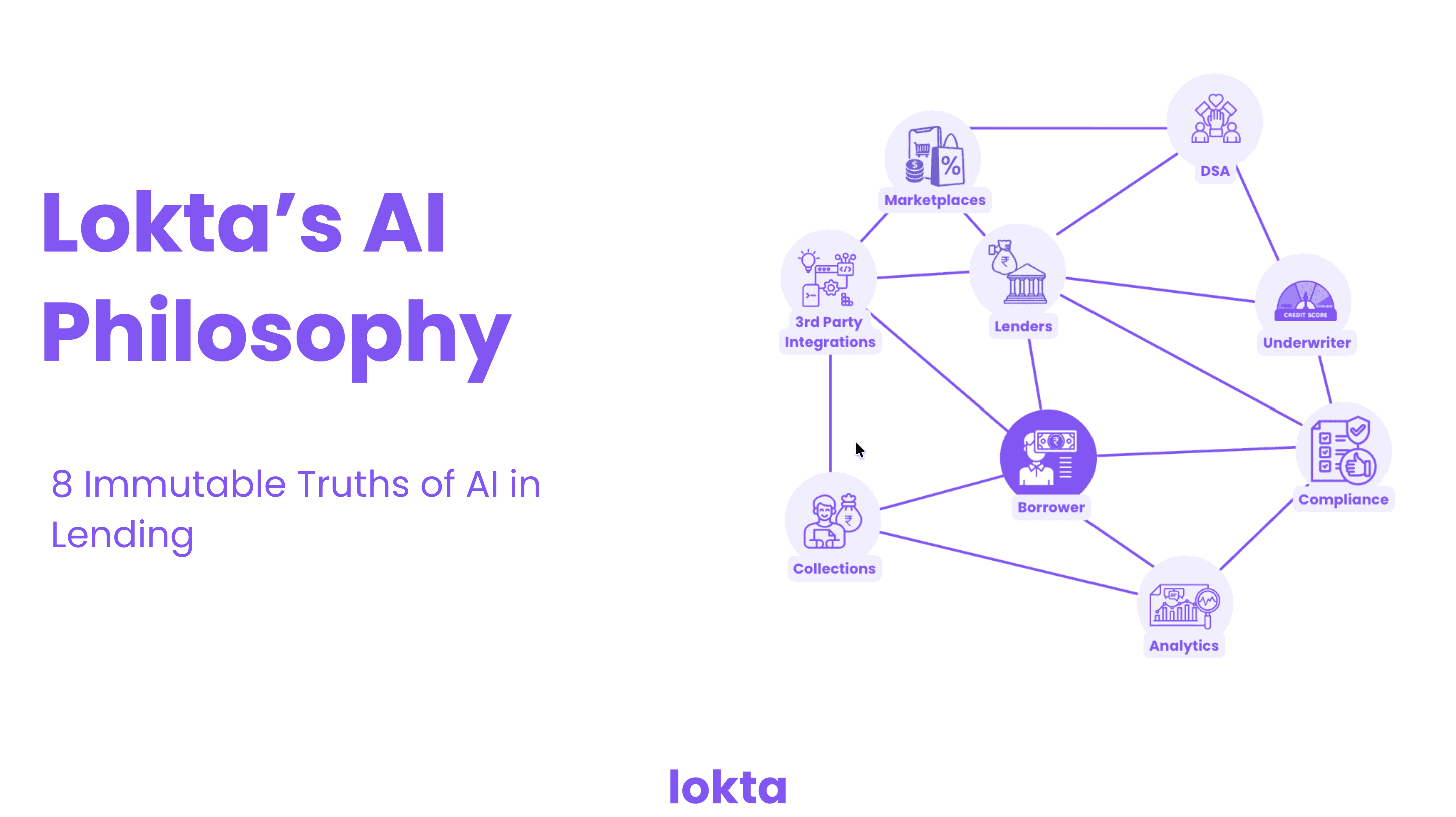
The integration of Artificial Intelligence (AI) is transforming the financial sector, but the application of AI in lending requires a foundational philosophy centered on trust, transparency, and accountability. Lokta’s approach defines a clear framework with eight immutable truths designed to leverage AI’s power while strengthening compliance and human oversight.
1. Deterministic Core, AI as an Intelligence Layer
At its heart, all core financial operations—money movement, schedules, regulatory records, and state transitions must remain deterministic and replayable. AI serves as an intelligence layer that sits above this core. Its role is to reason, orchestrate, summarize, and recommend, but never to "run" the loan book itself.
2. No Black-Box Decisions
AI at Lokta is expressly forbidden from making regulated, core decisions. The system is architected to prevent AI from becoming a black box. Key actions remain under human control and accountability:
Approving or rejecting loans.
Setting prices or waiving fees.
Triggering legal escalations or overriding controls.
These decisions are governed by the Regulated Formula: Rules + Human Accountability + Approval Matrix.
3. No Client Data for Training
To uphold privacy and ethical standards, Lokta designs AI workflows, not traditional ML models. The architecture is smart enough to rely on capabilities like:
Retrieval-Augmented Generation (RAG).
Prompting and Agent Tools.
Knowledge Graphs and deterministic simulations.
This approach eliminates the need to use sensitive client data for model training.
4. Grounded by Evidence & Policy
Every AI output must be provably connected to verifiable facts. The outputs include citations and constraints, ensuring a human can verify and an auditor can replay the decision process. AI recommendations are anchored to two pillars:
Evidence: Documents, bureau data, and system events with full provenance.
Policy: Versioned rules and Standard Operating Procedure (SOP) clauses.
5. Assistive & Advisory by Design
AI is designed to be a powerful assistant, not a final decision-maker. Its functions are limited to:
Drafting: Credit memos, narratives, and scripts.
Explaining: Risk drivers and reconciliations.
Suggesting: Scenarios, playbooks, and mappings.
Triage: Root Cause Analysis (RCA) and identifying missing documents.
Final decisions and commitments are always explicit, approved user actions.
6. Auditability as Architecture
Auditability is a non-negotiable, first-class artifact of the system. Every interaction with AI is logged, and "Explain Packs" are generated on demand. These packs document the prompt version, context sources, tool calls, final output, user edits, and necessary approvals, providing a complete trail from outcome to evidence.
7. Safe Iteration with Governance
Changes to AI logic are managed with controlled rollouts and robust governance. Prompts and agents are versioned, and changes are gated by safety measures and guardrails, including:
Deterministic test cases.
Real-case evaluation suites.
PII redaction and consent rules.
8. Human Agency Stays Central
While AI reduces operational burden and increases clarity, the ultimate responsibility for the loan book remains with human experts, including Underwriters, Compliance Officers, Finance Controllers, and Operations Leads. The product is built for transparency, ensuring humans can see why a recommendation was made, review the sources, and fully own the final decision.
The Lokta Philosophy