
Agents read the book
Software that reads the loan, decides what should happen next, and writes the proposal down before anything moves.
Servicing, monitoring, collections and recovery on one platform. Agents work the routine cases inside your guardrails, your team decides the exceptions, and every action lands on the record.
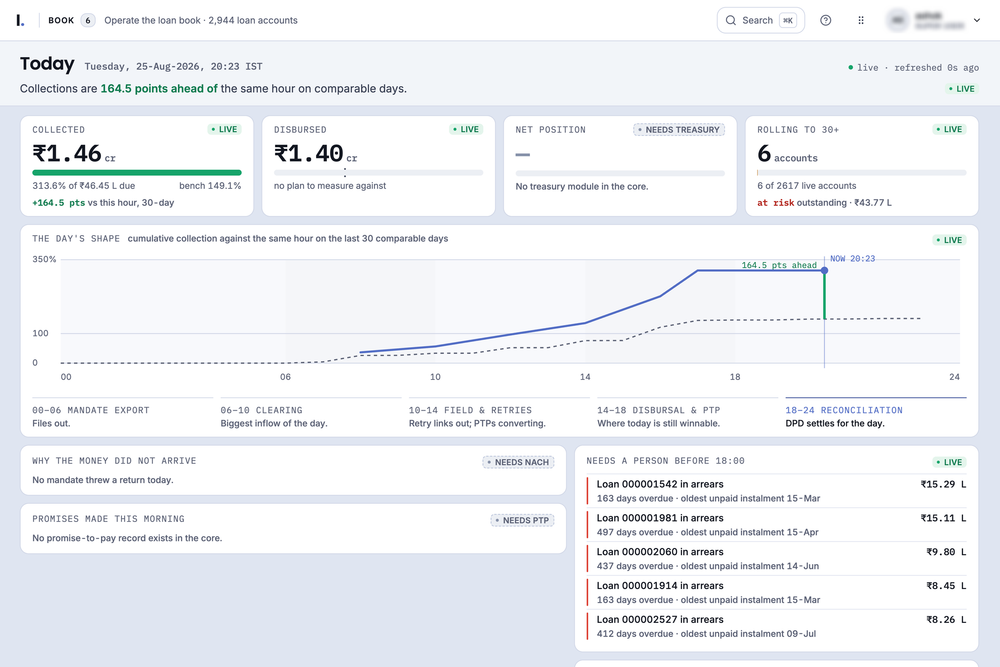
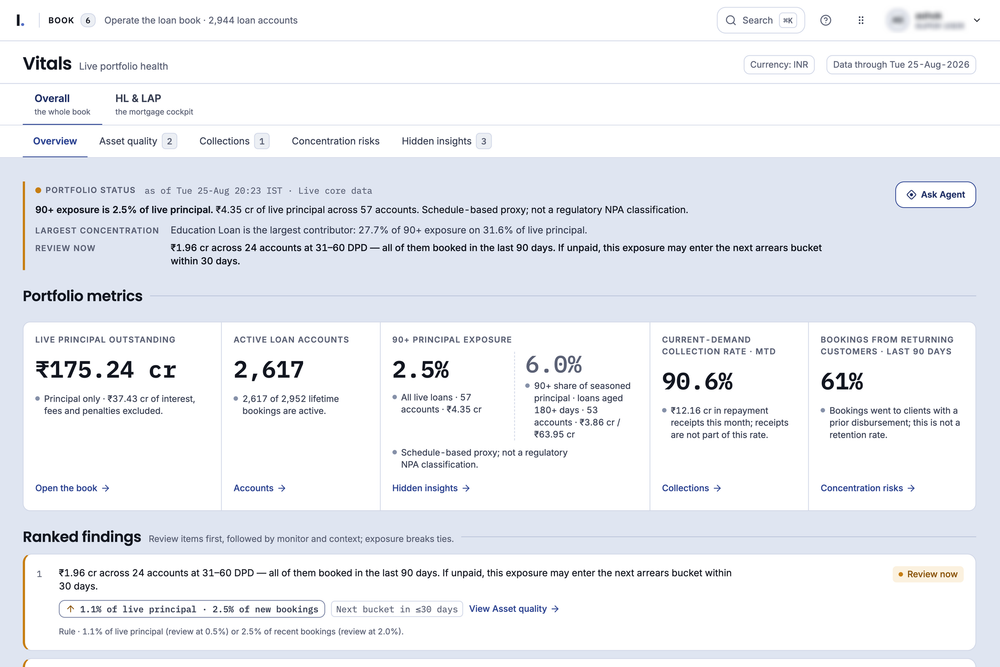
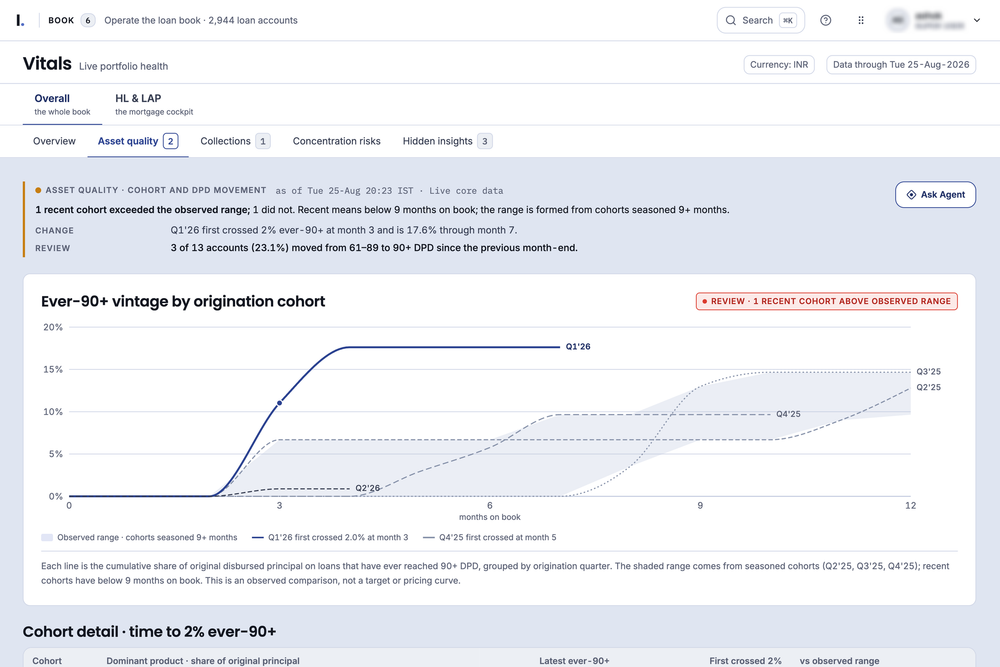
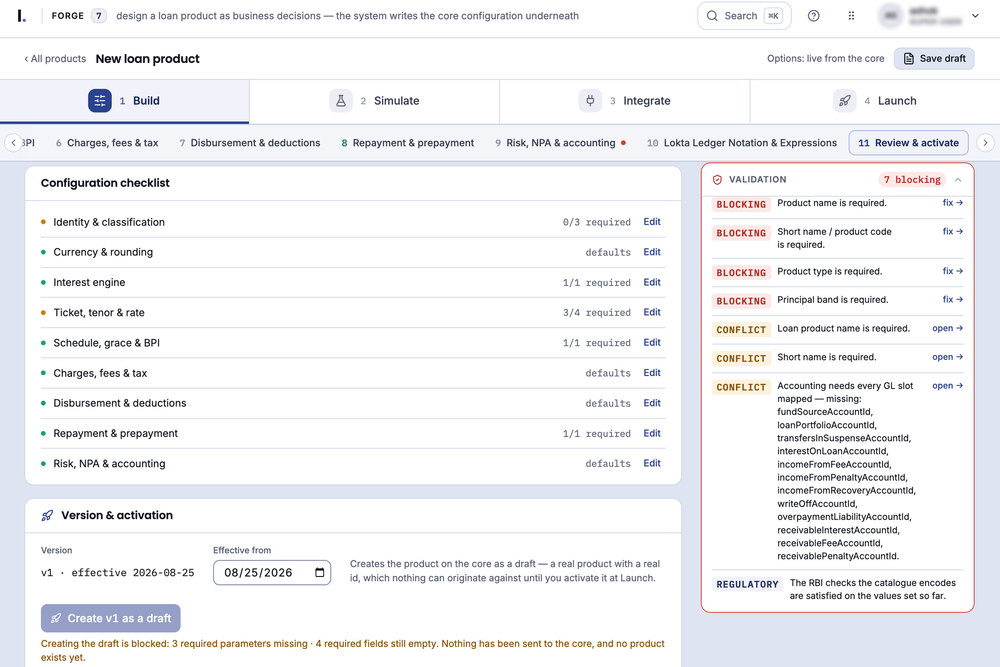
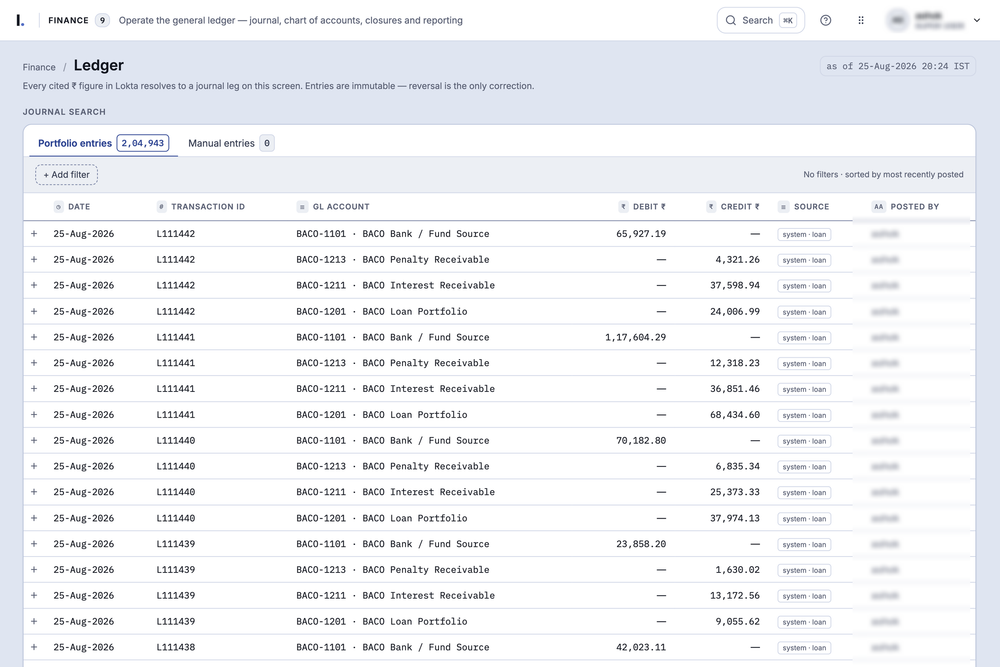
Lokta is the agentic loan servicing platform for NBFCs, banks, fintech lenders and lending service providers (LSPs). Lenders run the live book on it after approval, inside their guardrails: servicing, monitoring, collections and recovery on a deterministic core. Agents propose, the lender's core decides, the record proves it. From the team behind Apache Fineract, for lenders in India and beyond.
Built by the team behind Apache Fineract*, the open-source lending core used by lenders in 70 countries.
Aggregate impact attributed to the Mifos/Fineract ecosystem, not Lokta directly. Read the impact essay
Most businesses end at delivery. Lending begins there.
Each repayment and recovery on your book can inform the next reviewed policy. Whether it improved the outcome is measured, not assumed.
What came in, what did not, and which accounts need a person before the day closes. Servicing, collections and the ledger on one record, so nobody reconciles a spreadsheet to find out.
Payment queries, mandate follow-ups and promises to pay are answered and routed by agents, inside the limits your policy sets. Anything that changes the record passes your core's checks and approvals first.
Agents can evaluate hundreds of servicing and collections candidates in the time a risk team ships one. Your team decides what goes live, and the book measures whether it worked.
The goal is operating cost that stops scaling linearly with the book. Every agent action logged and replayable. Audit by design isn't the pitch: it's the price of admission.
The loan management system, collections, loan accounting and reporting, with maker-checker and a full audit trail from the first loan. Your current system keeps running beside it until the balances tie out.
NBFCs with AUM up to ₹100 crore at enrolment, excluding pure-play microfinance. The fee stays at zero for 24 months while AUM holds at or below the cap. A new licence with no book yet also qualifies.
Built by the original architects and builders of Apache Fineract. Lokta is what we'd build if we started today.
"You cannot run a bullet train on narrow-gauge rails. The track width is the architecture. That's why we started over."
Agent-native means the operators of the book are agents: software that reads the loan, decides, and acts. Every agent action is a governed write, checked against your policy before it touches the book.
Software that reads the loan, decides what should happen next, and writes the proposal down before anything moves.
Built and governed in AI Studio, the AI control plane authorises, scopes, logs, and verifies agent actions. A kill switch is built in. The agent proposes. It does not post to the ledger. Your core does.
Two ledgers, the same inputs always producing the same outputs, and state changes on the loan record replayable for whoever asks.
Servicing, collections, and compliance, all on one ledger, with a loan product studio and servicing agents on the same canonical model. Or keep your existing Loan Management System (LMS) and run the agents on top of it.
Lokta Ledger, the deterministic loan engine your book runs on, with the Loan Product Studio that composes each loan product on top of it. Every product is one versioned contract, not a configuration row. Audit-ready, schema-per-tenant, governed APIs.
See loan managementOne inbox across WhatsApp, email, phone, and portal. Lending-aware triage, confidence-based automation, every resolution feeding the borrower model.
See AI loan servicingConnect Lokta to an existing loan system through a lender-specific data contract. Each rail, bureau, or partner connection is separately scoped, mapped, tested, and accepted before use.
See what Lokta runs onContinuous model-risk governance mapped to RBI's 2026 draft: validation, monitoring, and evidence organised for lender review. The regulated entity owns interpretation, submission, and accountability. Lenders under another supervisor's model-risk regime get the same validation, monitoring, and evidence structure.
See model risk managementLoan Origination is on the roadmap and is not available now. No release date is published. Read the roadmap design
Deploy on-prem, in your VPC or on single-tenant cloud. Maker-checker at the policy boundary, and an audit trail on every state change.
For banks & NBFCsModular services, OpenAPI 3.1 and Keycloak-native identity. Extend it in your own codebase rather than through a vendor change request.
For fintechsMulti-partner from the core, per-partner isolation and audit, co-lending reconciliation native to the data model.
For LSPsIn lending, the autonomy you can audit is the only autonomy that scales.
A small number of institutions at a time: banks, NBFCs, and fintechs building a deliberate adoption, not a SaaS sign-up. If you already run a book, nobody is asked to cut it over. Three ways in, depending on the book you run.
The trade: before any loan moves, we agree with your risk and compliance people what the pilot has to prove. That is slower than a SaaS sign-up, and it means the first result is one your model risk review can check rather than take on trust.
The full platform with no platform fee for up to two years, then 1 basis point a month on AUM. Application-only. Four questions, no documents.
On your book and your policy, not a generic demo. Write in and a founder usually comes back within one business day, with times or a straight read on fit.
Three things you can use without a sales call.
On every path
Every agent action lands on the record before it lands on the ledger, so a model risk review has something real to check, not a screenshot.
Agents read, draft, route, and propose. Deterministic checks and required approvals control record-changing actions.
Repayment and recovery evidence can update reviewed hypotheses. Improvement requires a measured result.
Every enquiry is read by one of the founders, Ashok Auty or Chandramouli C S. Who they are
Every enquiry gets an answer. Sometimes it is a 30-minute call to dig in, sometimes it is "not yet, and here is what would change that."
Read what we're building towardApache, Apache Fineract and Fineract are trademarks of the Apache Software Foundation. Lokta is not affiliated with, sponsored by or endorsed by the Apache Software Foundation, the Mifos Initiative, or any other company named here.