Next Decade LMS
Mar 30, 2026
The Bullet Train Problem in Lending: Why Legacy LMS Won’t Power the Next Decade

Ashok Auty
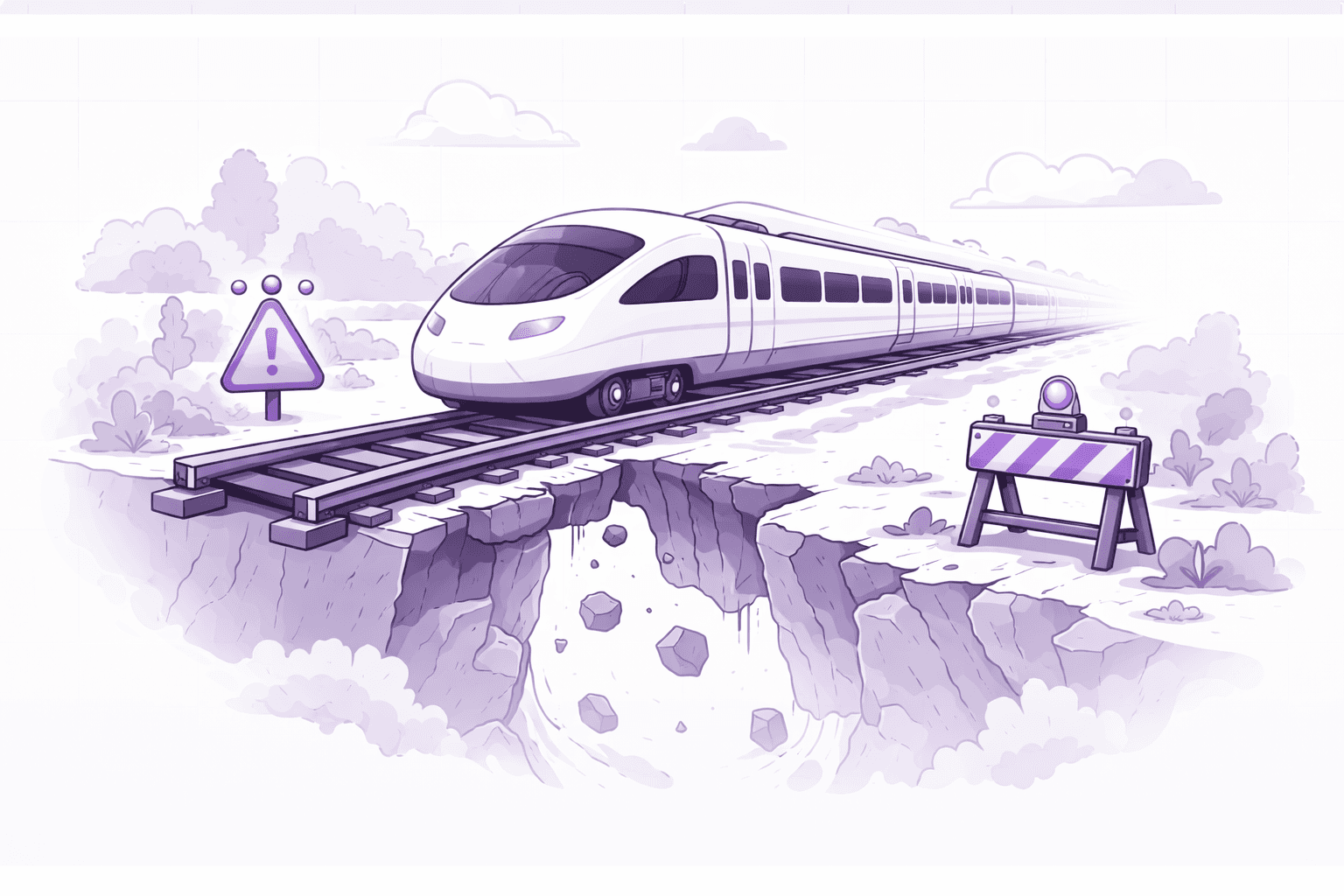
Everyone talks about the bullet train. Almost nobody talks about the rails.
High-speed rail isn’t just a faster engine. It’s new track standards, new signaling, new safety systems, and new operating discipline—built as one integrated foundation. Without that, the “train” is irrelevant.
Lending is reaching the same inflection point.
Agentic AI workflows are the bullet train.
Legacy Loan Management Systems (LMS) are the narrow-gauge rails—built for a world of batch processing, manual operations, and slow change. You can add dashboards and bolt on AI assistants, but you can’t safely run the next decade of lending execution on foundations that weren’t designed for it.
That’s the bullet train problem in lending—and it’s why we chose to rebuild LMS from scratch at Lokta.
The Shift: From Systems of Record to Systems of Execution
Traditional LMS platforms were designed to record activity: disbursements, schedules, repayments, fees, charges, notes, and reports. That remains valuable. But the next decade is changing the job of the platform itself.
Lending operations are moving from:
human-led work → workflow-led execution
screen-driven actions → tool-driven actions
periodic compliance → continuous compliance
insights → supervised systems that act
In plain terms: an LMS is becoming an execution engine.
And execution engines must meet a higher bar: repeatability, governance, traceability, and correctness at scale.
What “AI-Ready” Actually Means in Production
“AI-ready” is often mistaken for having a chatbot, a dashboard, or automated messages in collections. That’s AI-assisted UI—not production-grade AI readiness.
For serious agent workflows in lending, AI readiness means the platform can reliably support:
1) Analytics-grade data readiness
AI needs stable semantics, consistent identifiers, derived metrics, and outcome labels. Most LMS schemas are built for transactions, not for feature-friendly, governed “Customer/Loan 360” views that models and agents can depend on.
2) Full-lifecycle domain events (AI-grade eventing)
Agent systems depend on events the way high-speed rail depends on signals. It’s not enough to publish a few lifecycle events. You need a complete event catalogue, schema versioning, idempotency guarantees, replayability, and “exactly-once enough” patterns so downstream systems can trust automation.
3) AI plumbing and governance
Production AI needs more than a model endpoint. It needs logging of inputs/outputs, evidence attachments, prompt/model versioning, and monitoring. It also needs unstructured document ingestion lifecycles and retrieval patterns. Most legacy LMS products weren’t built to ship with these layers because they weren’t designed for agentic execution.
4) Orchestration as a first-class product surface
Maker-checker is necessary but not sufficient. Agentic workflows need case management, tasks, SLAs, escalation, rework loops, committee approvals, and provenance. If orchestration lives in external tools, you lose traceability and consistent execution.
5) Security and observability for AI-era integrations
Once automation can execute actions, the security bar rises: scoped tool permissions, safe write-backs, and end-to-end traceability. In regulated lending, you need to answer “what happened, why, who approved it, and what evidence was used” reliably—every time.
AI readiness is a systems property. Not a feature. The Hidden Multiplier: Agents Create 5–10× More Execution Load
Here’s the insight most people miss: agents increase backend demand. They don’t reduce it.
Humans compress complexity in their head. Agents can’t. They must explicitly fetch, verify, compute, orchestrate, and log—through tools and APIs. That changes system load from “a few screen loads and updates” to “many small reads, validations, workflow calls, and structured write-backs.”
In practice, agentic workflows often generate 5–10× more tool/API calls than human-driven flows.
If your platform isn’t designed for that multiplier, AI doesn’t scale operations—it exposes bottlenecks.
A Collections Example That Hits Home
Consider a common use case: Next Best Action for 30–90 DPD accounts.
Human-driven collections (point-in-time, async):
A collections agent opens an account, checks dues and last payment, skims notes and PTP status, decides the next action (call/WhatsApp/field visit), and logs a short outcome. Most context stitching happens outside the system through judgment, messages, and manual lists.
Typical load: ~8–15 backend calls per account.
Agentic collections (dynamic, synchronous execution):
A governed agent must fetch a complete “Collections 360”—dues breakdown, charge rules, contactability, consent, previous outcomes, PTP history, mandate status, bounce reasons, risk/legal flags—then validate policy constraints like quiet hours and frequency caps. It orchestrates tasks, SLAs, escalations, and logs evidence + rationale as structured outcomes and events.
Typical load: ~60–120 tool/API calls per account.
Now multiply that by scale. At 10,000 accounts/day, you’re looking at:
human-driven: ~150k calls/day
agentic: 600k to 1.2M calls/day
This is why “data readiness” isn’t a nice-to-have. It’s the bottleneck. Agents don’t fail because they can’t draft a message. They fail because the rails can’t supply consistent, replayable, governed truth at high frequency.
Why Legacy LMS Feels Fine—Until You Try to Run the Bullet Train
Legacy platforms can support incremental automation. But agentic execution stresses the foundation:
fragmented semantics across LOS/LMS/Collections/Analytics
partial event coverage without replay or governance
outcomes trapped in free-text notes
orchestration scattered across tools
weak decision trails (“what happened” without “why”)
You can bolt on AI. You can’t bolt on the rails required for governed execution.
The New Rails: What a Next-Decade LMS Must Provide
To be truly AI-ready for lending execution, the platform needs:
Deterministic financial truth (dues, postings, reversals, schedules—auditable)
Canonical Customer/Loan 360 views (stable identifiers, derived metrics, outcome labels)
Full-lifecycle event catalogue (schema versioning, idempotency, replayability)
Workflow-first orchestration (cases, SLAs, escalation, committees, rework loops)
Governed agent tools (scoped permissions, safe write-backs, structured rationale)
End-to-end observability (what/why/who/when across system → AI → write-back)
This is not “more features.” It’s a different foundation.
Why We Rebuilt at Lokta LMS
We didn’t rebuild because legacy LMS systems are “bad.” We rebuilt because they were built for a world where humans execute and systems record. The next decade is the opposite: workflows and agents will execute—under governance—and the platform must stay correct, auditable, and reliable under a 5–10× execution multiplier.
You can’t run a bullet train on narrow gauge rails.
And you can’t run the next decade of lending execution on legacy LMS foundations.
If you’re a lender modernizing operations—or a fintech building lending agents that must survive production reality—the rails matter more than the train.